Every blood test you've ever had gave you a list.
We built a map. One sample, one run, hundreds of markers, read as one body.
A wellness product, not a diagnosis. Nothing to buy yet — first invitations go out in order.

An alpha account's BioMap at its second test.
Same person. About a month later.
Two better. Three need more attention. Three unchanged. The map re-reads itself.
Since your last test
2 better · 3 need more attention · 3 unchanged
Two tests are a shift worth re-checking, not a trend.
An alpha account's BioMap, Test 1 to Test 2.
Most people stop at the word “heart.”
One fat balance, high. Four heart-tissue proteins, typical. The fats moved, the proteins didn't.
What's behind this
Heart & lipid risk
needs attention24 markers measured · 19 outside typical
Omega‑6:omega‑3 balance (AA:EPA)
arachidonic acid (an omega‑6 fat) to EPA (an omega‑3 fat)
needs attentionwell above typicalHeart-tissue stress markers
galectin‑3, fibronectin, lumican, vitronectin
finetypicalLipoprotein(a)
finetypical
The heart & lipid view, opened.
Good. Fine. Watch. Needs attention.
No reading is called abnormal, and each one says which direction is better for you.
- good
past typical, on the favourable side
- fine
within typical
- watch
a little off typical; close to fine, worth a look next time
- needs attention
clearly outside typical in the direction that matters for this reading
Your blood is an orchestra.
Proteins, metabolites, lipids, toxicants. Omni-MS records every section in one take — 100 µL, one run. Invented at UCLA, patented in six countries.
Austin QuachCofounder & Chief Science Officer, Dalton Bioanalytics · inventor of Omni-MS
- Proteins
- Metabolites
- Lipids
- Toxicants
Every reading is a position, not a verdict.
Measured against a study cohort: “well above typical”, never a number with units, and not a diagnosis.
375
interpreted
4,765
more measured, not yet interpreted
Ask out loud. She moves the screen to what she's explaining.
She explains any reading, shows you where it lives, and takes you through the rest, by voice or in text. When the answer is a doctor, she says so.
She won't
- Tell you what's wrong with you.
- Name a dose.
- Tell you to start, stop or change a medication.
Shelly
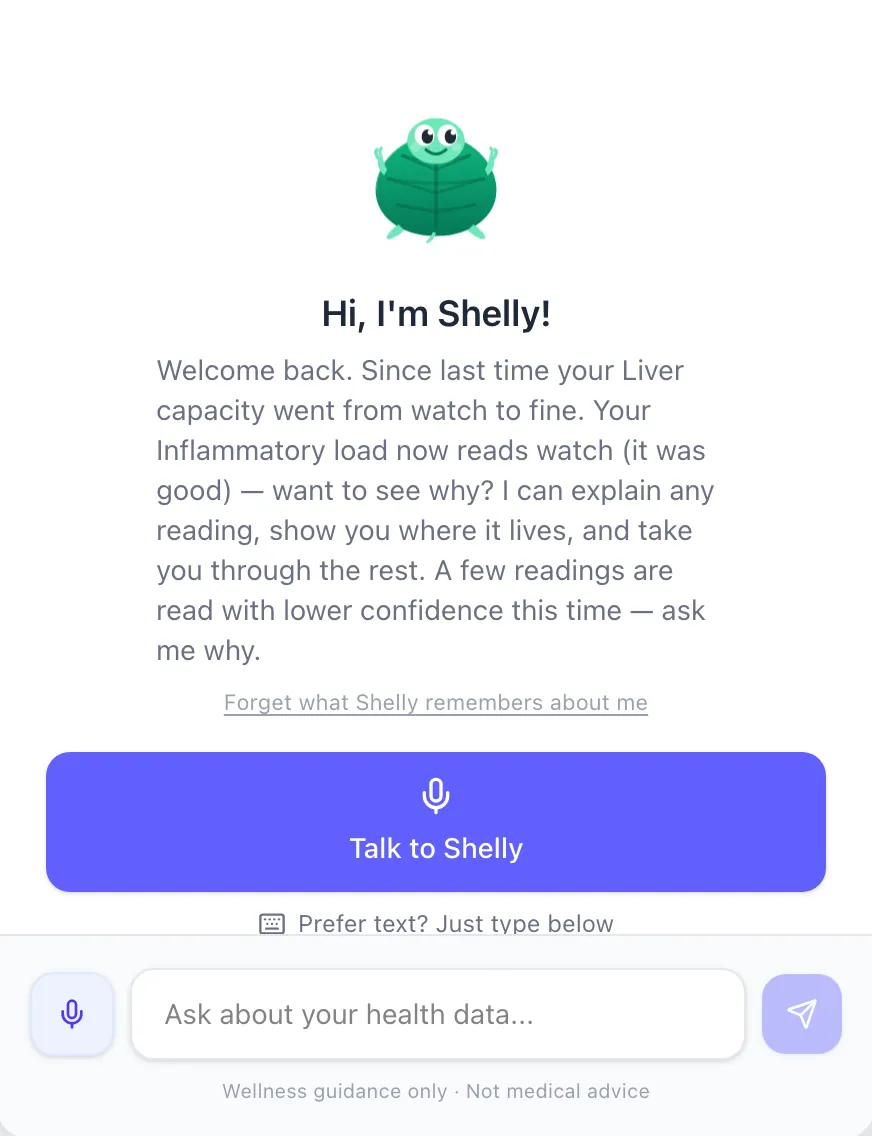
Shelly's opening message, after the second test.
It starts free.
More oily fish before any supplement; each step tagged with its marker and a re-test window.
Your plan
A few things worth doing — drawn from your results, free first, never a prescription.
Start here — free first, from your report
Eat more B3-rich foods (meat, fish, legumes, whole grains) and protein foods
Vitamin B3 statusre-test in 6–8 wk
Not a prescription — the same list as your dashboard's “What to do now”.
For your top findings
Omega‑6:omega‑3 balance (AA:EPA)
needs attentionWhat could helpre-test 8–12 wk
Increase oily fish or dietary omega‑3
The plan, as the product lays it out.
One page, written for your doctor.
Built to be handed to them, not to go around them.
- Sample context
- Anything about the day of the sample that shifts readings, stated before any finding.
- Ranked findings
- Ranked the way the analysis ranked them, each with its cohort-relative score.
- Favourable, reliably measured
- What reads well, not only what reads off.
- Change over time
- What moved between tests, with its caveat attached.
Wellness test summary — for discussion with a clinician
Values are cohort-relative standard scores (z); this assay reports no absolute concentrations. Screening-grade wellness data — not a diagnostic result.
Sample context (applied as interpretation lens)
Ranked findings (pipeline order preserved)
- Omega‑6:omega‑3 balance (AA:EPA) — high
- Young red-cell fraction — markedly atypical
Favourable, reliably measured
Antioxidant reserves
Change over time
Caveat: Only 2 timepoints and cohort-z (no personal baseline or technical replicates), so individual-analyte change is unreliable…
The doctor page, top: its own headings and a few of its rows.
Five things we won't do.
Each one is enforced in the product.
We never diagnose.
You will see patterns worth attention — never “you have” a condition. Only a clinician who examines you can say that.
We never invent numbers.
No manufactured scores, probabilities, or “biological age”. If a number appears, it was measured.
Counts, never risk scores.
Condition checks read “3 of 7 linked markers lean toward” — a tally you can verify by tapping it, not a percentage.
Your context reads first.
Recent hard exercise, your cycle, a non-fasted sample — anything that shifts readings is shown as a lens before any flag.
“Not measured” means exactly that.
A marker we could not measure is said plainly — never silently dressed up as normal.
Test. Live. Test again.
One test is a note. It takes a few to hear the tune. First invitations go to the waitlist, in order.